







Uncensored Conversations - Thanaphon Accawatanyu
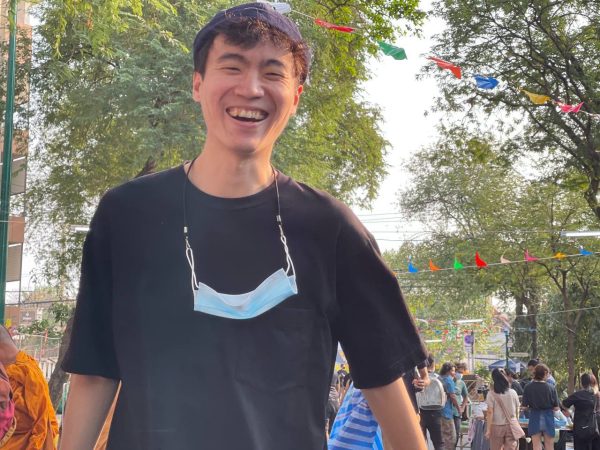
Alfian: Let’s start with a brief introduction of yourself.
Thanaphon: I am Thanaphon Accawatanyu. I’m a playwright and a director and I have a group called Splashing Theatre here in Bangkok. And I’ve been doing theatre work since 2014.
Alfian: Is it common in Thailand for playwrights to also be directors?
Thanaphon: Yes, it’s a very small scene. So, most of the time, when the project starts, it can start from the producer, or from the director or the playwright. And I think around 80% of the artists here, they are both the playwright and the director. It’s also about the cost. If one person is both the director and playwright, then we save money.
Alfian: Yeah, I asked this question because it’s increasingly common in places like Japan, for example. But I noticed that in Malaysia, in Singapore, I think because of the British colonial system, we also follow certain trends in the UK and the US where playwrights are seen as quite separate. And these countries still do a lot of very text-based works. So you can have career playwrights like Carol Churchill or Tony Kushner, and they are just playwrights, they don’t often direct their own plays. So I think we have followed that kind of model. You mentioned economic constraints, but I also think the nature of the work influences whether you have separate playwright and director. Especially if people are dealing with movement-based works, or multimedia-based works, there’s perhaps less of a role for a playwright.
Thanaphon: And sometimes it’s a devised work. Sometimes the director just gives a situation or a scene and lets the actor generate the dialogue by themselves. It’s a method of creating the text. Sometimes I do that also, but not so much. I tend to write everything down. The old and classical way.
Alfian: Just to share, here in Singapore, when we want to stage something, we need to apply for a license. And that means submitting our script to the censors. And then we can’t change anything in the script. So for those two months we can rehearse, and then whatever changes we make, we have to keep on updating the censor. Of course it’s created this situation when it’s not ideal. Because you freeze your script for at least two months and then you’re stuck with that. And that I think goes against the idea of exploration and discovery in rehearsals. What is the situation like for contemporary theatre in Thailand?
Thanaphon: We’re all underground.
Alfian: Really? But I’ve seen some of your works at the Bangkok Art and Culture Centre, which is a very public place. It’s an institution.
Thanaphon: What I mean is we are a very small scene. So you could say that the government doesn’t know we exist. So, technically we could stage anything we want. When I started out, I didn’t have any knowledge about the bureaucratic process of staging a play in Thailand. Whether you need to send the script to someone or inform them or something like that. I also didn’t know about how the big theatre companies work. There are just two big companies that do commercial stage shows. I’m not sure whether they have to apply. The underground and independent scene is really separate from the commercial and mainstream scene. They don’t watch our shows, and we don’t watch theirs. So we don’t know how they do it, but we just do anything we want. Most of the time the government doesn’t know or doesn’t care. But sometimes the government starts to pay attention when the play makes the news, or creates intense discussion among the public, like on social media. One of the cases that illustrate this is Bang La Merd by Ornanong Thaisriwong.
Alfian: This was the restaging, right? Because the play had been performed earlier without incident.
Thanaphon: Yes, it was restaged shortly after the coup, the latest military coup, in 2014. And I think the police just saw the title. Yeah, because the title is quite…it’s not offensive, but it would attract their attention.
Alfian: The English translation in the publicity write up was Bang La Merd, The Land We Do Not Own.
Thanaphon: I think it means more than that. It’s more like the land that has been taken away from the people. Or the land that’s been violated. Yeah.
Alfian: So the English translation was quite tame!
Thanaphon: I think the title appeared on some website, so the police were alerted, and they came for the show. And I think the artist had to change something in the script when the police were present to watch the performance. In the restaged version, in 2015. The first version in 2012 talked about the law, Article 112, which criminalises criticism of the king and the monarchy. It states, “whoever defames, insults or threatens the King, the Queen, the Heir-apparent or the Regent shall be punished with imprisonment of three to fifteen years.” It touched on the case of 61-year-old Amphon Tangnoppaku, or “Ah Kong”, who was accused of sending four messages to the secretary of the Prime Minister at that time, Abhisit Vejjajiva. He was sentenced to twenty years in jail under 112 and the law on computer-related offences. During the first year of his sentence, he died in prison of liver cancer. But the artist had to make some amendments when a member of the military came to watch the show.
Alfian: Yeah, I’ve read the play. It’s published in that great play anthology called Micro Politics.
Thanaphon: When the military came to the production, they told the producers that the performance had to be authorised by them first. So yeah, that’s the first time we learned that we had to get authorisation from the military. But yeah, after that, I think there was no specific case where the military would come to watch a show at the theatre. It’s just a fear in our head. That someday the military might turn up.
Alfian: Ever since the military said that you have to submit your script, did anyone do that after Bang La Merd?
Thanaphon: No. Because none of us knew how to go about it. We don’t even know who we have to deal with. Is it the police, the military, or the culture ministry? I think the censorship in Thailand now is only concentrated on films and video games.
Alfian: So even you don’t know what is the process if you need to get approval?
Thanaphon: Maybe it’s my ignorance, but I can assure you, 90% of the people in the theatre scene don’t know how to submit their script for approval.
Alfian: That’s good though, because I believe in the practice of “do first, apologise later.” Don’t ask people for the rules because then they will spell it out and they will try to restrict you.
Thanaphon: And this is a very Thai philosophy. Don’t ask, don’t tell, just do it.
Alfian: And then only when they scold you, you say, “Oh, I didn’t know.” In Singapore, that strategy is called “act blur”. So do you think the authority is under the police, the military, or the Culture Ministry?
Thanaphon: Well, it’s under the Culture Ministry, I guess. You mean the censorship, right?
Alfian: Yeah, the censorship.
Thanaphon: I think it’s combined with the police also. Because in the past, I remember that I submitted some films to the police for censorship. So the police have their film committee, the people who know about film and the people who specialise in certain parts like religion or the law. Like the Apichatpong (Weerasethakul) film, Syndromes and a Century. He was censored for three scenes, not because they were political. These three scenes included one where there was a monk playing the guitar. And there was another scene that showed a female doctor drinking some alcohol. And then there was male doctor who had an erection. Yeah, so the monk’s association—the Buddhist association—and the doctor’s association in Thailand, they didn’t like those scenes.
Alfian: That’s interesting that they are considered important stakeholders who can decide that their image is being affected.
Thanaphon: I think the government thinks that the film shouldn’t offend anyone. But the reason is very stupid. The doctor is drunk? Come on. There are doctors who drink.
Alfian: I never understand this kind of taking offence, because it’s a character, it’s an individual. One character does not represent all monks, another character doesn’t represent all doctors. In Singapore, we have those issues, but it usually comes from religious people. There are definitely similarities between our two countries. Other than the case of Bang La Merd, is there anymore that you know of?
Thanaphon: There’s a work by B-Floor again, called Flu-Fool. It was first performed at the BACC in 2010. It was about a contagion that had spread in society, requiring state of emergency measures. So looking back, it was like an omen for COVID. When it was staged, there was no trouble at all. Then it was restaged in 2020. We recorded this second version and we wanted to screen it. But because it’s a film, we had to send it for censorship.
Alfian: Oh oh.
Thanaphon: Yeah, it’s a very physical work. So it’s very hard to understand at first.
Alfian: Quite abstract?
Thanaphon: Yeah, but the images, the visuals are quite direct. But not the story telling. And then, the censors had a problem around four or five scene. And the ones who dealt with this was the police in this case. And they told us that if we don’t do anything with five specific scenes, then this film cannot be screened at all. There was a scene where the actors raised empty frames. Empty floating frame. And the police said, “This is a very familiar image in Thailand. Everyone in Thailand knows who’s in that empty frame.”
Alfian: I guess they’re referring to an image of the king? Because I see those official portraits everywhere.
Thanaphon: Yeah. So we don’t know what we should do. Maybe we can send the film again. I mean, the same version, but now to a different committee. Maybe we can have a different interpretation by them.
Alfian: I find this really interesting, because you have a situation where it’s okay as a play, but once you migrate to another medium, which is film, suddenly, it becomes a greater target of surveillance and control and censorship. In Singapore, we had Elangovan’s banned plays, namely Talaq, Smegma and Stoma. But the thing is that once it migrates into a book, it’s okay. So it looks like censorship as performed by the authorities is in many ways influenced by the medium in which it is presented, right?
Thanaphon: Oh, now that I think about it, there are two cases involving theatre that have become quite legendary case studies in Thailand. The first case is, do you know the 6th October incident?
Alfian: That’s the massacre at Thammasat University in 1976, right? It was a violent crackdown by the Thai police and paramilitary against leftist and student demonstrators. They were assaulted, some lynched, some beaten to death…
Thanaphon: Yeah, yeah. At Thammasat. One of the reasons that got people angry to was a performance. In September, two labour activists had been beaten to death in a town outside Bangkok. Their bodies were hung from a gate. On 4th October, students from Thammasat staged a play to re-enact this hanging. The next day, a right-wing newspaper published photos from that play, and they claimed that the student who acted as one of the hanged man looked very similar to the Crown Prince. The students were accused of insulting the monarchy and the army gathered its forces to storm the university.
Alfian: It gave them a pretext to move against the protestors.
Thanaphon: Yeah, and it really provoked many members of the public, who hold the monarchy in high regard.
Alfian: A tragedy created by fake news.
Thanaphon: The second case study happened around the recent coup. It’s a play called The Wolf Bride. It’s actually a student play, presented in 2013 at Thammasat University. It was satire, about a fictional king and his adviser. Then we had the military coup in 2014, and they were looking for targets to use Article 112 on. And unfortunately one student and one activist were arrested for their involvement in the play, and sentenced to around 2 and a half years in prison. So these three cases: October 6 at Thammasat University, the Wolf Bride, and also Bang La Merd, they are very present inside our head. For every artist doing political work, or theatre work in Thailand.
Alfian: Does this awareness lead to a lot of self-censorship?
Thanaphon: Yeah. I mean, it’s not just when we’re doing our work, you know? Self-censorship is really part of everyday life. We do many things not out of conviction but out of fear. When we’re in the cinema and the national anthem plays, everyone stands up. You don’t want to make a scene. In daily life, we are very fearful to say something about the monarchy in public. So, yeah, when it comes to self-censorship, it’s just become a habit. Not only by artists, but Thai people in general also.
Alfian: But how does self-censorship affect theatre practice? For example, if artists are writing something, do they choose something abstract or they choose metaphor, to find a way to veil or hide the criticism inside their works?
Thanaphon: Yeah, we do this as a strategy. We’re always doing this all the time.
Alfian: Okay, so let’s move on to this work called Deleted Scenes in Southeast Asia. It was on online work that premiered in 2021, under the Bangkok International Performing Arts Meeting programme. Three plays that were censored or banned in their home countries would be directed and performed by artists from another country. So there was an Indonesian and a Singaporean play translated into Thai, and a Thai play translated into Indonesian. And you directed those first two plays.
Thanaphon: That’s right.
Alfian: I’d like to focus on the play from Singapore, which is by Elangovan. It’s called Smegma and it was banned in 2006. At first they were given the license and an R18 rating 4 days before the opening. But the license was suddenly withdrawn 1 day before the opening.
Thanaphon: Do you know why?
Alfian: Their official statement is that the play “undermines the values underpinning Singapore’s multi-racial, multi-religious society. The play portrays Muslims in a negative light.” They also stated that they convened their Arts Consultative Panel and that “the majority found most of the content of the play insensitive and inappropriate for staging. The members were concerned that the play could create unhappiness and disaffection amongst Muslims.”
Thanaphon: Do you agree with that?
Alfian: First of all, I think it’s very sloppy, not to mention unfair, to give a license, and then to withdraw it afterwards. It suggests that you have so much power at your end that you can act according to your whims or caprice, without serious repercussions. Or it could also suggest that your decision-making process is not robust, and decisions can be reversed if there’s pressure from who knows where.
Thanaphon: What about the reasons for the ban?
Alfian: What’s interesting for me is when they said the play “could create unhappiness and disaffection amongst Muslims”. But surely there are already Muslims in the Arts Consultative Panel. Were they unhappy? Did they feel disaffected? It’s not clear to me. Who’s speaking? Who are the aggrieved? Are they speaking on behalf of a hypothetical Muslim complainant? How is this person imagined?
As for the portrayal of Muslims in a negative light, let me just say that there is practically no character in Smegma who is portrayed “positively”. Everyone is so deeply flawed—violent, cowardly, lustful, exploitative. Some have no redeeming features whatsoever. There are proto-terrorists and sex workers who happen to be Muslim, but there are also sadistic soldiers and abusive employers and smug sex tourists who happen to be non-Muslim. It’s already suggested in the title, that no character is going to come out of this play smelling like roses.
Thanaphon: What do you think of Insurgency?
Alfian: I believe the insurgency refers to the separatist tensions in the South of Thailand, where a primarily Malay population in the Pattani Malay region is fighting for more autonomy from Bangkok. As a minority whose culture shares much in common with that of neighbouring Malaysia, there are concerns about Thai-ification or forced assimilation. In the scene, two soldiers—one Thai, one Singaporean—are interrogating a local woman whose husband had apparently abducted a Singaporean soldier. In the world of the play, Singaporean soldiers had been posted to the Pattani region as “observers”.
Thanaphon: Did this really happen?
Alfian: I don’t really know. Obviously the military has its secrets. But the performance scholar Catherine Diamond did ask Elangovan about this and he replied that he got his information from a Thai journalist.
Thanaphon: But to you, did it matter if it was based on something real?
Alfian: To be honest, not really. I treated it like a work of fiction. My understanding is that Elangovan has not had first-hand experience of what was happening in the south of Thailand. In Insurgency, you have a Singaporean soldier who goes to Thailand and doesn’t know anything about the situation. He’s there supposedly as just an observer, but actually he’s very ignorant. And I think this is Elangovan’s way of saying that for all our military training in Singapore, soldiers are really not prepared for the realities of war, of violence and insurgency. The meta thing for me is that I feel that Elangovan himself as a Singaporean is also quite ignorant. And gaps in information are filled with imagination. I feel that the scene is more a critique of the naivete and the ignorance of Singaporeans than it is a critique of the violence in the south of Thailand. But I would like to hear from you actually. When you first read it, what was your impression?
Thanaphon: It was very weird. Because stories from the South, they don’t get much attention in plays or in films.
Alfian: Is there a media kind of blackout on the happenings in the south?
Thanaphon: I mean, we read it about it occasionally. Like maybe three times a year, we learn that there was a bomb blast, or there was violence. It was really weird to read the play and realise, “Oh, it’s about the South.” And weirder that it was written by a Singaporean.
Alfian: I’m looking at a map right now. And it almost looks like the distance from Bangkok to Pattani, in the south of Thailand (1040 km) is almost equal to the distance from Singapore to Pattani (980 km).
Thanaphon: I would say that Pattani feels very far from Bangkok. And even myself, I haven’t been there. You could say I’m very Bangkok-centric. I was born in Bangkok. I’ve lived here for 30 years. My only relationship with a place like Chiang Mai is as a tourist. I have no relatives there. All my family is in Bangkok, so my life is in Bangkok. And of course we feel the political distance from the South because the culture is very different, the food and the language are different.
Alfian: As I mentioned just now, I saw the events in the scene as fiction. What about you?
Thanaphon: Same. Because I don’t know. It could be real because I didn’t know what exactly happened out there. But knowing the Thai government, I think their soldiers could be capable of [using torture as an interrogation tactic].
Alfian: Can you tell us how you approached your direction and dramaturgy of that text?
Thanaphon: It was very hard because I didn’t want it to directly reference the South. The main reason was because at that time I didn’t have much knowledge to say anything critical about the South. When I read the script, I was quite lost. I didn’t know how to present it. So my eventual solution was to try to create it as neutral as possible. I don’t need to mark it, with a set and costumes and props, to indicate that it is “the South”. The text is very specific and very direct about the violence. But for me, I always deal with violence in my plays in an indirect way. The violence is often hiding in the subtext, in the subtle things.
Alfian: So, you didn’t feel like you needed to enact the violence? In some of the stage directions, it says that the soldier “stomps and kicks the female” and “grabs her right hand and breaks her finger”.
Thanaphon: There is already violence in the way they talk to her. So I thought, I will use this method, which is try to present the text as it is, as much as possible. Don’t decorate or exaggerate it. Just present it as it is.
Alfian: I do think that there were some directorial choices that I really liked. For example, in your version, the soldiers don’t really have any contact with the woman. Instead, they throw ping pong balls at her, and spray what looks like mist from a disinfectant gun at her. And I somehow feel that this is more violent because it suggests that she is so abject as to be untouchable. Can you talk about some of your design choices? Like the costumes?
Thanaphon: The two soldiers were wearing a black glasses and hat, and the lighting was quite dark so it was hard to see their face. And the woman’s head was censored. It was masked with a blurring effect.
Alfian: I like that because it alludes to the fact that this was a censored work. But also, the philosopher Emmanuel Levinas talks about “the face of the other”, as the root of a kind of ethics. If you really, really look at the face of the other, then you wouldn’t be capable of violence against them. And for you to take away her face, it’s portraying how the soldiers probably look at her. It’s dehumanising, right? You’re taking away a person’s humanity by taking away her face. What about the multimedia?
Thanaphon: I had static projected on a back wall. And it formed a layer over the actors’ faces.
Alfian: For me, it’s a reference to how we can’t really know what’s happening in the South. I think the media is either not allowed there or people think it’s too dangerous to report from there. So the information is unclear or corrupted. And at the end of the work, you have this coda where you show clips of protests and police violence, police brutality. And it’s all accompanied by a quote from Malcolm X. Incidentally, Elangovan himself used his quote as an epigraph to Smegma. And one of the lines from that quote is: “I believe it is a crime for anyone who is being brutalized to continue to accept that brutality without doing something to defend himself.”
Thanaphon: Because the work is about deleted scenes in Southeast Asia. These are clips about the government committing violence against their people. I’m showing images that governments try to delete from public memory. And it’s not all from Thailand, it’s from different parts of Southeast Asia. I think there are some from Myanmar, and some from Cambodia. The ones from Myanmar were very recent, because there had just been a military coup.
Alfian: You staged Insurgency online, in a regulatory grey zone. You managed to present the work in so-called “international waters” where we are not subject to the laws and jurisdictions of certain countries. My question is, could you stage it in Thailand as a short, live performance?
Thanaphon. I think so, yes. I mean, in recent years, people tend to be more open. Especially regarding the political situation outside Bangkok. People have become more knowledgeable and informed. And the media try to provide more coverage about the South. Recently, we just screened the film, a documentary film about the South. And it didn’t face any problem, as I remember. So I think it can be staged.
Alfian: Do you think in general, with this new civilian government that’s replaced the military one, there’ll be more opening up when it comes to censorship?
Thanaphon: I don’t know. I mean, I don’t know what they’re going to do about certain laws or about Article 112. I don’t know.
Alfian: You know, in Singapore, we can’t even hope for change. Because we know the government is not going to change.
(Uploaded: 15 March 2024)