







Uncensored Conversations - Lee Mun Wai
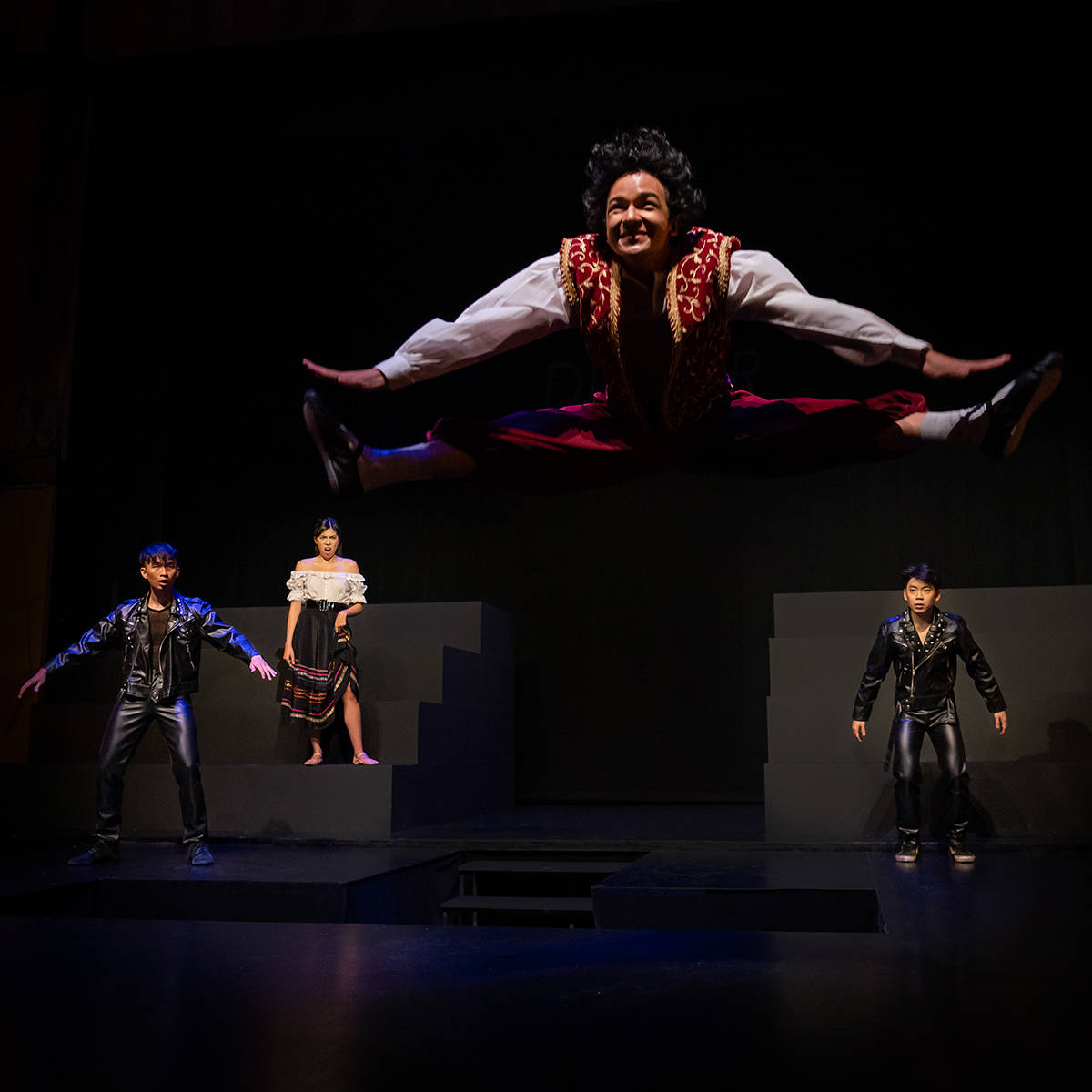
Alfian: I want to talk about this project, which is Dancing the Good, the Bad and the Ugly. It was performed for the Vault Residency under Centre 42 in 2017. And if I remember correctly, it was part of Centre 42’s attempts to explore affiliations between theatre and other art forms.
Mun Wai: If I’m not wrong, it was because Centre 42 didn’t want to just be a lifeless repository of text. I felt this was their way of saying, “The text needs to meet the present and this is one of the ways”. If it doesn’t just meet a theatrical body, then it would be a dancing body.
Alfian: So they were interested in interdisciplinary explorations, right? And I suppose looking at the text as not just being re-staged, but activated. Especially a text where there’s some kind of historical sedimentation or accretion of meanings. So how did they approach you, and how did you eventually decide to work on Elangovan’s three banned plays—namely Talaq, Smegma and Stoma?
Mun Wai: I knew (Ma) Yanling from Centre 42 because she was also dancing for the Second Company at T.H.E Dance Company. She told me there was this series called The Vault and asked if I would be interested in responding. It was the perfect time for me because I had just left T.H.E, having grown quite dissatisfied with its format of artistic expression after being in the company for seven years. I was getting increasingly bored of the mode of aesthetic production through an athletic body. Basically, “Just look at me and my beautiful self, at what you cannot do and what I can do.” This was not making any more sense to me, and I was getting totally injured. It seemed like they wanted to produce a body that was constantly giving off spectacle.
Alfian: So with a focus on virtuosity?
Mun Wai: Absolutely, right. That’s the right word. And in being the founding member, I had actually shelved aside a lot of personal interests in my approaches to art, which was to use the art form to engage with dynamic socio-political dimensions. And so of course, when I left the company, I jumped at the opportunity to do something with Centre 42. I guess there’s a kind of textual dimension that I always enjoy. I really enjoy language. And I was always trying to find ways to bring together the language of dance with textual language.
Alfian: Why did you choose these particular plays? Did Centre 42 show you a database of works for you to choose from?
Mun Wai: I’m pretty sure, in this foggy memory of mine, that it started out with me wanting to engage with things that had already created problems or friction or controversy. It’s a very personal and central thing in the way I practice my life and my art, that it needs to constantly question limits and borders, and it cannot be too comfortable. I had several conversations with Robin Loon and Yanling so that they could get a better sense of my curiosities and interests in themes and context. They then gave me a shortlist. I think Ovidia Yu’s plays were part of it. But I settled on Elangovan. Maybe also because at that time I was going to Books Actually to browse around. I saw The Good, The Bad and the Ugly. And I bought the book because I was so excited. I thought, “Hang on a second. Isn’t this banned?” Then someone told me, “No, the words can be published, but you cannot perform the words.” And I told Yanling, “Hey, I just bought this book. Can I respond?” And she said, “Okay, okay, can. See how you do it.” I don’t remember her giving me a lot of trouble.
Alfian: So she was open to the idea.
Mun Wai: Yes. No objections. And I recalled the time when I was an art student, reading the news about Talaq being banned by PELU (Public Entertainment Licensing Unit), back in 2000. It was so unceremoniously put down. And that for me didn’t sit well.
Alfian: Were you following those controversies closely?
Mun Wai: Just reading headlines. And then maybe the first two paragraphs. But never delving into the longer arguments.
Alfian: But what was your surface impression of it at the point of time? There was a very dramatic episode when the police were summoned to the Drama Centre. And the director S Thenmoli from Agni Koothu (Theatre of Fire) was arrested for trespassing.
Mun Wai:I greeted the news with a lot of cynicism. Also a lot an anger. Because then I found out what the play’s topics were. And I thought, “But someone has to talk about the injustice that happened to this woman!” Why is this community not owning up to this and not wanting to hear her story? She’s already been silenced by her husband and her family, and you can’t even give her this reparative or cathartic outlet.
Alfian: To testify to her pain, right? So when you finally read the plays, what went through your mind?
Mun Wai: I mean…it was definitely an uncomfortable read . My skin crawled. Not in anger, but in nervousness. I did imagine myself sitting in the theatre and probably mouthing, “Oh my god.” Of course the first level of nervousness was, “Can this actually happen in Singapore? Will the cast be safe after they all leave? Will there be confrontations backstage?” I was imagining all these things. But then after that, I felt, “No, this needs to happen.” And then I quickly told myself, “Your discomfort doesn’t matter. This story needs to be told.” And then I started researching in-yer-face theatre (of the 90s), and playwrights like Sarah Kane and Mark Ravenhill. So I learnt that this is already a thing. It was more than just a very naive attempt to provoke. Elangovan knows what he’s doing; he’s employing form or moving through a form to tell a very important story.
Alfian: So you’re someone who I assume is politically liberal-progressive, with your art education. Yet you read these plays and felt discomfited. You were even imagining that the safety of both performers and everyone who worked on the production might be compromised. Did that make you see the rationale for the censorship?
Mun Wai: No, I’m a gay man who has always wanted to be femme-presenting. Growing up, I spent 10 years in an all boys school, and I had to always fight for myself. And as difficult as every day was, I did it. I think I was also influenced a lot by my personal approach to life, which is a little bit warrior-like, like, “Okay, you do one time, I do ten times back to you.” Very aggressive. Now, I’m a bit calmer. But every day was a fight for me because my friend and I decided to be openly femme. So, no. The way it was censored was not acceptable. The way the police came down and made a spectacle out of it—makes everything worse.
Alfian: So it shouldn’t have escalated to that point?
Mun Wai: It could have moved through a much longer discussion process. I don’t care if it moved into protracted engagement. But the moment you whip out the handcuffs, then nobody wins, right? No views get challenged. Here’s a community whose cultural habits prevent a victim from voicing out. And you lose the opportunity to turn the mirror back on that group to say, “Hey, but you know we need to address this, right? It cannot be completely correct that this happened, and we don’t talk about it.”
Alfian: I just want to go back to that scenario that you conjured. What if the censorship was “necessary”, on security or safety grounds? We assume that censorship happens because there are some people out there who are going to take offence. But what if that offence gets translated into an act of violence? You mentioned the people involved in the production, and whether they’re going to be harassed backstage. Or members of the audience could create a disruption in the middle of the show. And therefore, to avoid the possibility of those things happening, the censors made this judgement call. I’m just playing devil’s advocate right now.
Mun Wai: But are you saying the judgement call includes sending down the police? Because it still doesn’t warrant that style of censorship. All the theatre company wanted to do, after finding out that the play was banned, was to perform the play without an audience and document it on video. I think they could have said, “Hey, Elangovan, we are not allowing you to stage it now. We need to move through discussions. We need to bring the groups affected into dialogue.” Because there was a group of people who were very clearly and loudly saying this play should not go on. But are they the only stakeholders? Who else should be brought into that dialogue? What about their voices?
Alfian: It was unfortunate that the dialogue pitted two groups against each other. On one side, you had the feminists from AWARE. On another side, you had the Muslims, represented by SIJU (South Indian Jamaithul Ulama or South Indian Council of Theologians) and MUIS (The Islamic Religious Council of Singapore). And the only person who embodied both identities, of being woman and Muslim, was the actress Nargis Banu herself. It would have been interesting if there was a roundtable with Indian Muslim woman representatives, or the Indian Muslim women Elangovan interviewed, because they would have the most authoritative claims to the story. It was the year 2000, and we didn’t have the vocabulary to talk about intersectionality.
Mun Wai: So that’s why I said you need time and resources. To move through communities and institutions. You need a lot of patience and facilitation.
Alfian: Let’s jump to the play Stoma, the one about sexual abuse within the church. There was the character of the paedophile priest, right? Again, you risk having Christians protest the work, and some might not do it in a peaceful manner. So obviously censorship is one way out of this potential flashpoint. But what are the other ways you think we can approach this?
Mun Wai: I don’t know. I mean, when Stravinsky premiered the Rite of Spring [in 1913], the audience was up in arms.
Alfian: Yeah, we hear these urban legends, about people rioting in the theatre.
Mun Wai: And aren’t we also fighting for a kind of theatre that’s not tepid? That moves within the dynamism of the socio-political space? I guess on the day itself you can have a lot of security protocol. It could translate to needing more manpower. Thank God we don’t have guns here. But the moment something weird or untoward happens in the show, you could pull the plug. Lights on. And then the show stops halfway. I guess when a play such as Talaq or Stoma gets staged, we have to be prepared, no? How did we prepare for Pink Dot?
Alfian: They beefed up security, right? They put up barricades and screened the attendees. So I think that’s one of the approaches.
Mun Wai: And in Germany, when you have a protest, the police follow you. To protect you against your naysayers.
Alfian: Yeah, I think that we forget that sometimes the police can be there, not to oppress you, but to protect your freedom. Because that’s the power that we as citizens have invested them with, right? The state’s monopoly to wield legitimate violence. So then we should have some expectations of their duties. In a country which values freedom of assembly, freedom of speech, of association, the police should be protecting those freedoms. Although sometimes I feel like over-securitisation increases tensions. So imagine if everyone must be frisked and undergo a bag check before you go into the theatre.
Mun Wai: Yeah, that also introduces another set of problems.
Alfian: But let’s say, you invite someone from the Christian community to write something in the program booklet. Maybe a counterpoint essay to things that they might disagree with. Accommodate their right to insist that this is not a representation of all Christianity, even though by watching the play you can already make the conclusion. That this is an issue that’s happened within the church, but it’s a certain segment and it’s not an indictment of the entire religion. Also, could there be a talkback session where you invite people who are unhappy about it to come on? It could be another way to defuse some of these tensions. Because I think tensions exist when people feel that they cannot get their points of view across.
Mun Wai: I’m really thinking very hard now. Because it’s beautiful how we are so generous in wanting to build this support structure. For what are obviously plays written to poke you right where it hurts, right? So all I’m going to say is, let’s not pretend that no one will react. But then what we are describing now is the generosity of a very mature, organised community that says, “We need to protect this work, and we are going to offer resources and space to mitigate.” So we acknowledge the audience’s sensitivity, but do we pander to it if it’s a form of denial? We also need to remember that Elangovan’s plays were not just shooting off for the sake of it. They were addressing actual cases. The plays’ approach was very grating, but they were not speaking nonsense. I understand that every society has its taboo topics. The way it’s impossible to have a nuanced discussion about Israel in Germany. Maybe it’s the trauma of race and religion that Singapore once experienced, and we’re not far away from the trauma. But for me, the plays were talking about very important things.
Alfian: What are some of these important things?
Mun Wai: For example, the rape in Talaq, marital rape. And I think it’s very difficult to navigate because some communities don’t believe that rape can occur between married couples. And the members of the community might or might not have access to different points of view. But I think in a very fragmented cultural space like Singapore—where we try to live together, and we are inevitably influenced by each other’s behaviours, habits, and beliefs—I think that can be turned into a productive thing. Where people who don’t like being in a situation can choose to leave. Find another community. I think it’s important that the alternative voices of any community always get an airing.
Alfian: I think there are two main difficulties in looking at the play Talaq. One is the very fraught question of representation. When it was performed in Tamil, although there was some controversy, it did not escalate as much as when they wanted to restage it in English and Malay. So there was this anxiety of a minority community in Singapore, namely the Indian Muslim community, who have not had a lot of representation on stage either in Malay theatre or in English theatre. And suddenly…
Mun Wai: The moment of representation is this one.
Alfian: Yes, and I have some sympathy for that. Their coming out party, and it’s a show on domestic violence. So, this crisis of representation. The second difficulty is the dilemma of multiculturalism. So there are group rights and there are individual rights, right? Individual rights would be like civil liberties, something that is universalised and should apply to every citizen. However, there are also these group rights, which is about the autonomy of each group to be able to maintain their own particular religious and cultural practices. And the argument from some quarters is that within Islam, supposedly, we don’t recognise marital rape, because once you have entered that marriage contract, you have a duty not to withhold sex from your partner. The focus is on the contract, and not consent. And there are additional tensions when you have legal pluralism. So if you’re Muslim, family law falls under the Administration of Muslim Law Act. So you have the syariah court for family law and then the civil courts for everything else.
Mun Wai: But that said, the performance of the play in this multicultural space, allowing that person to bring her story to light, does not disrupt this law, in any significant, immediate way yet. I feel this person, Nargis Banu, needs to have the individual right to speak about something that she thinks is problematic in that space. If she lives in a much more culturally homogenous space, it might have been impossible. But because we have this multicultural environment, then these things can come to light. How we negotiate that might take generations. Maybe the community doesn’t change. But the censorship already kills the expression of the opinion. And when this can’t even be expressed, these institutions never get challenged. And isn’t that also a problem?
Alfian: I think we also need to be careful that we don’t fall into saviourism. There’s a risk of suggesting that there are superior and inferior cultures, and that some communities need to be, for want of a better word, “civilised” or “modernised”. The way some forms of feminism are articulated does reek of this colonial mission to “save” Muslim women from supposedly patriarchal Islam. And I think this often results in defensive postures and a counter-denigration of “Western” feminism. However, I think with Talaq, it’s clear that the grievance and the sorrow is being expressed by a Muslim woman. Elangovan had interviewed 11 Indian Muslim women. So it’s dissent from within the community.
Mun Wai: Yes. This character in the play spoke for at least one person in the community.
Alfian: Can you walk us through that process of how you tried to put these censored plays into your work?
Mun Wai: I think the clearest part for me was the textual dimension. I felt that I needed to insert the text back into the public space. Admittedly, I was also afraid of censorship because Centre 42 said, “You do have to submit your script.” And I thought, “I must find a way to include the text.” You just have to be creative about these things. So I took out these text extracts, wrote the words in reverse order and I removed all punctuation. In designing the submission document, I used the “justify” spacing for my script. So it looked like a very neat block of text. It looked almost pictorial.
Alfian: But why did you have to submit some kind of text to IMDA? What if the whole work was just movement without text?
Mun Wai: I think at the time, when I’d just left T.H.E, my body was still moving in very stylised and formal ways. I still hadn’t moved out of that phase. My approach to movement was not radical enough to bring forth in a very immediate way the sense of Elangovan’s work. My trained dancer’s body would have been inadequate. I also felt a personal responsibility to the work. If I stand up and say that I do art that wants to be socially and politically engaged, my first goal is to try and put the words back into the public sphere.
Alfian: Can you describe the process of how you introduced the text into the work? I noticed that there were two fragments that you took out and recited during the performance. Two were from Talaq, and one from Stoma. The first was a parable about a salt doll that went into the ocean. Its whole body was dissolved by the waves, leaving only its mouth. The second was an account of an abortion. I thought that was very clever, because those two bits were re-contextualised within the work. I read them as a commentary on the individual’s right to expression, and how censorship robbed the plays of their chance at life. And the third was a graphic description of a sex act from Stoma, which formed the ending to your work. I remember feeling unsettled watching it, because you repeated those same lines, but changed the pronouns, for example, from “he” to “she” to “them”. And with each pronoun shift, I found myself imagining the scenes anew, with new bodies, and it was strangely exhausting. I understand that you also produced a score where you recorded a reading of the text.
Mun Wai. Yeah. I combined the significant parts of the scripts and then I rewrote the text backwards. And I did a sound recording of the words, racing through the reading. So that achieved for me two things. It inserted the words back into the public space, albeit backwards. Which also reminded me of how some Christians say that some songs played backwards had hidden Satanic messages! Secondly, it also became a rhythmic assault, a sonic assault.
Alfian: But in addition to those words, you were also trying to translate the verbal into the gestural. What are some examples you worked through?
Mun Wai: (Performs some gestures, including putting out his middle finger, and some hip thrusting.)
Alfian: I guess those capture the scatological aspects of the plays!
Mun Wai: At that time, I knew I had to translate the plays, but I would not be satisfied if it was just this literal translation. Because in my movements, the vibrations that were there were too subtle, they were not in your face enough. At some point I was really trying to find how I could put as much slam back into the thing. I mean the script slaps you left, right, centre. For me there’s something about the body…when adult audiences receive performances of the physical, it never hits as hard as if a word comes to you. And that’s why I think dance is always a little bit more slippery than text. The moment I say, “Fuck your mother”, it’s very clearly something that makes you go, “Wow, OK.” Even if I do this (shows a middle finger) it doesn’t have the same effect. Words disturb and jab you in a very different way. And I was just trying to achieve that because Elangovan’s words did all that to me.
Alfian: So, we’re talking about translation into dance, right? You can have a faithful translation that can lead to literalism. On the other hand, you can have a freer translation, and that can lead to abstraction. Was there this negotiation between the too literal or too abstract?
Mun Wai: I was trying to avoid going in either direction. And I didn’t want to completely remove all textual elements. If this context of working with Centre 42 offers me the possibility of having texts, why fight the tide? Use it. Because wouldn’t it be great to have a body vibrating and the text vibrating and then both hit you? Because they vibrate in different ways.
Alfian: I’m still wondering about a purely non-verbal performance. What if you had gone through a completely literal route, which is to enact whatever was in the text, to turn it into some kind of mime performance?
Mun Wai: I think I would have been laughing hard. I think everyone would be laughing too. But it’s an interesting thought exercise.
Alfian: Or what if you stripped the plays down to the stage directions? And used them as units of construction.
Mun Wai: It already sounds like a doable movement score. And if we do this show again, then you and I could go into a deeper unpacking. I would love to. It’s an unfinished discussion.
Alfian: In the piece, you made these movements, and I remembered that they were sometimes tentative, grotesque, and you had this stunned, slack-jawed expression. There was one section performed in darkness, and you held a small pencil torch that you used to shine at various parts of your body.
Mun Wai: Okay, now I remember. That part where I was shining light on myself was an image about trying to sexualise the body. This kind of voyeuristic observation, where the light would linger on the nape of the neck, for example. I was trying to imagine what would have happened in the scene, in the actual traumatic act. It was a way to make myself and the audience sit with this thing. “Okay, here’s my nipple, here’s my V line (iliac furrow).” Make us sit with the discomfort. And there was a moment where I would be flopping like a fish right? That was the rape. I was trying to translate these energies and to understand them without being literal. How would these energies translate into a movement that could trigger very basal responses from the audience?
Alfian: I felt that the flashlight carried many different meanings. On one level, I was confronted by the vulnerability of the victim. The victim of paedophilia in Stoma and of marital rape in Talaq. But on another level, I also saw the forensic examination of the script at the hand of the censors. I sometimes feel that my surrendering of the script to the censors is a form of violation. It’s a body search. Completely intrusive, with almost sexual elements to it. Because when you are doing the body search, not only are you claiming the right to touch certain private parts, but you’re also inspecting body cavities. So those things coalesced for me in that really powerful image.
Mun Wai: So in summary, Elangovan’s words hit me. They stabbed a knife, a dagger in my body. I wanted to see if through the language of dance that was in my body, I could bring that stab to the audience.
Alfian: The ending of Talaq was mostly non-verbal. Which is basically Nisha taking off the purdah, revealing her white attire underneath, and walking into a green light. And it’s a very ambiguous image because taking off the purdah might mean she was denouncing the religion. But then she’s walking into this green light which is a symbol of Islam. I was wondering whether you combed through the script to locate these loaded non-verbal parts which you could use as starting material for your piece.
Mun Wai: So this is the caveat, right? I really worked through the script only. As it was published. And I didn’t do this contextual background work to find videos of Talaq for example.
Alfian: You mentioned earlier that you were afraid of your own work being censored. Were you nervous about how the censors would respond to your work?
Mun Wai: I wasn’t nervous in a, “Oh my god, they will shut me down” kind of way. I was nervous that they would touch me in some way when I was already not doing the plays its most ideal justice. I was delivering the text backwards and I’m sure only a few of those in the audience were familiar with the scripts. I think for a lot of people, it was just, “Wow, he spoke really fast, and he sounded like a devil child.” After some point, I realised maybe that’s why I dance. Because the body is much harder to capture. Because the body can be very ill-disciplined. We’ve seen dance that tries to be agitprop, or dance that holds up hegemony. But there’s also dance that…that’s why parents don’t want us to go clubbing because it’s an assembly of these ill-disciplined bodies.
Alfian: I think what you have done by putting the work into the non-verbal space is to point out a weakness in the whole censorship regime in Singapore. Which is that it’s logocentric. It’s really dependent on having a script that it can vet. But the nonverbal has always given us that wriggle room.
Mun Wai: In the non-verbal space, most of the time they’ll just ask, “Got nudity or not?” They can’t say much else.
Alfian: That said, they have been known to investigate stage directions that are vague or too brief for their liking. They’ll ask stuff like, “What items of clothing come off? How long is this person nude for? Is this same-sex kiss on the lips or cheeks?” So, for me, you were kind of exploiting a certain loophole within the censorship system. Were you conscious of doing it?
Mun Wai: It felt like I was saying, “Elangovan, I will do you this favour, because I’m a dancer.” It didn’t affect my choreographic decisions. But always at the back of my mind I was thinking, “This is your job. Because they don’t know how to censor you. So somehow find a way to put that intensity back.”
Alfian: So the other thing that’s struck me is that we always talk about a dance with the censors. This is quite meta, but did you feel that your negotiations with the censors were also a form of choreography?
Mun Wai: Yes, I felt I was dancing in the dark. And then some person was telling me that there is someone on the other side. And I must tango with this nebulous thing. Though I don’t know where the OB markers are.
Alfian: In the end, you did accomplish the reinsertion of Elangovan’s words into the public space. But also, in a severely distorted form. One could even say in a compromised form. You had messed with the integrity of the work. Do you think you ultimately achieved what you had you set out to do?
Mun Wai: In short, yes, in as much as it’s a humble contribution. Where through another art form I’m putting the performative energy of the plays back into the public space. Because two of the texts had not even been performed. I think I gave it a small life. The fact that when I go back to Centre 42, and I do see that it’s been recorded…when Elangovan’s name hadn’t been mentioned for a very long time. Heaven forbid that we develop Tiananmen-style cultural amnesia. We are authoritarian but we’re not at that level. And Euginia Tan later did an adaptation of Smegma. When I saw the publicity email, I went, “Yes! The second one after about five years. So every five years we can be reminded.”
Alfian: What’s really fascinating for me is that your work poses a question: after censorship, what survives? But embedded in the work is also the performance of censorship. So you were displaying to us this thing…after the assaults and all the strangulation, this thing in its very desiccated form.
Mun Wai: The mangled child. I was the mangled child of censorship.
Alfian: Yeah. But you were also showing us the violent process at which it arrived at this state. Your movements were often ugly and misshapen. Maimed and stunted. I’d written somewhere about your work: “a body that knows it cannot be free, and therefore contorts itself against imagined barriers and limits in a delirium of self-abuse.” As an audience member I was thinking, “I see this, but now I want to see the real thing.” I think you planted that curiosity and desire in the audience. Either to read the book to start with, or to desire that this thing be given its full realisation.
Mun Wai: I feel like this is one version of the mangled child and is not the full child. You can also pull it apart, and then we can do many other versions. I don’t think they’ll be pieced together. But until the point where we are allowed to do the plays in their entirety, the only way to keep them alive is to keep on referencing them. When I was doing this Vault residency, one of these sentences that kept going through my head was, “Look, this is not done yet.” You shut this up, but it’s not done. It’s forcing itself out, it’s finding a form.
Alfian: Yeah, you can’t just bury it, right?
Mun Wai: This is your wound and it’s something that you’re going to have to deal with.
Alfian: And that’s one reason why I think Centre 42 has a potential to be radical. Because when the tendency is towards amnesia, then having an archive is radical. We draw power from the resources that help us to remember.
(Uploaded: 12 March 2024)