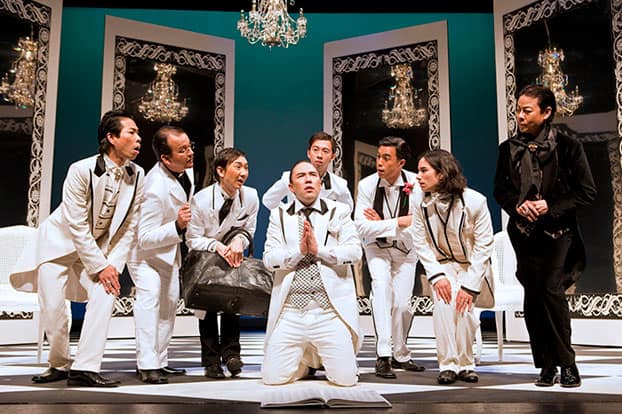






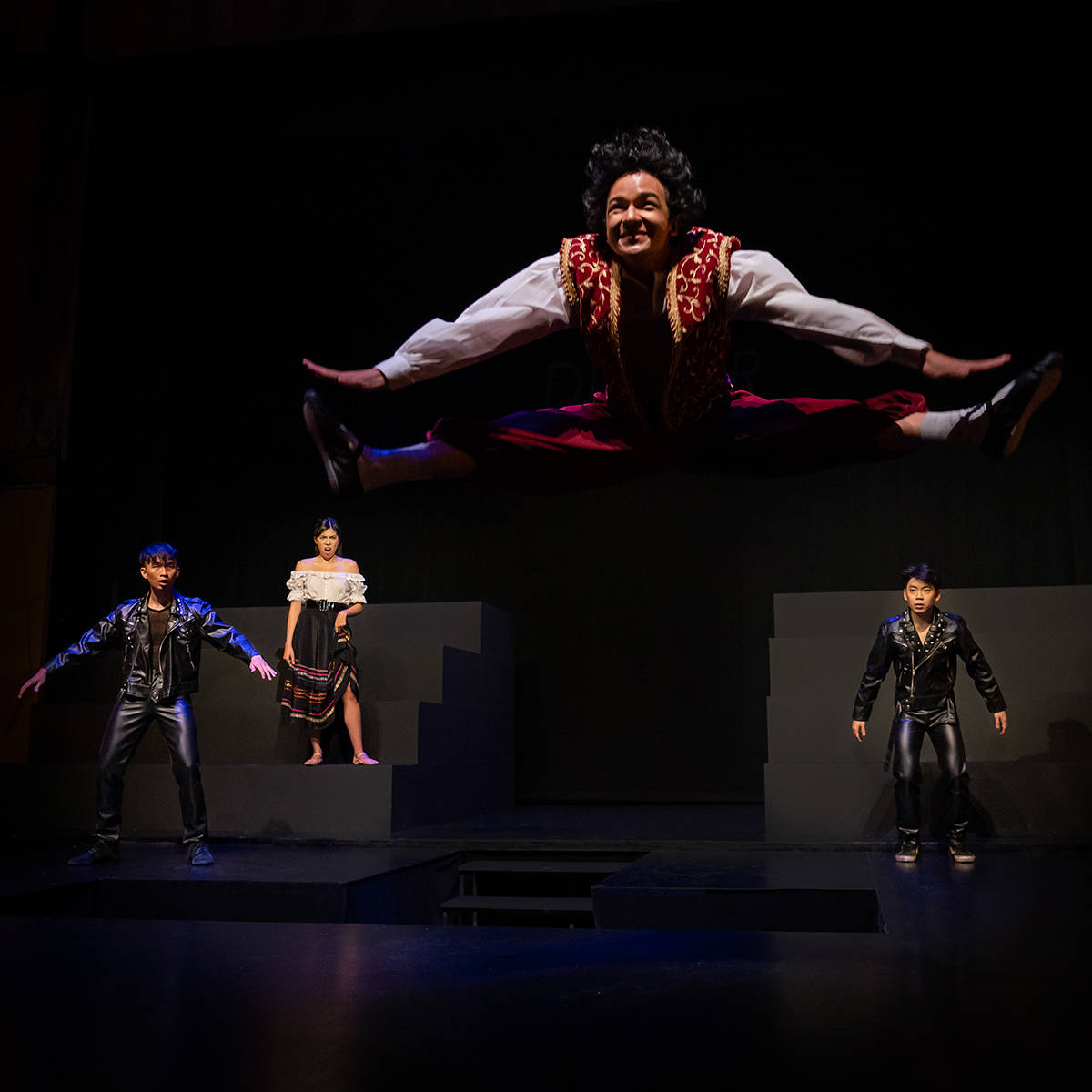


Check into a hotel, and you’ll meet people from all over the world. W!LD RICE’s HOTEL is no different! Ben Cutler and Moo Siew Keh, checking in from London and Malaysia respectively, will both be making their Singapore stage debuts with this production. They share with us the joys and challenges of performing in this epic of historical proportions.
HOTEL is a collaborative piece – how did you fit into the picture as a member of the cast?
Moo Siew Keh: Ivan and Glen chose a team of actors to participate in two workshops, all of whom could give input according to their very different backgrounds. For instance, I speak Cantonese and Japanese, and my knowledge of both made it into the play. The way it worked was through improvisation. We would research and gain an understanding of what was happening in Singapore in, say, 1965, and then we would improvise a story against that backdrop. These stories are then rewritten and refined by our playwrights, Alfian and Marcia.
Ben, you joined the production relatively late, after the workshops. How much input did you have into the script?
Ben Cutler: Actually, I’ve gotten in on that process quite quickly! I was expecting to just be here as an actor. But the show is so massively devised, and there have been a few drafts of the script since I’ve joined the production. So I’ve had a hand in re-shaping some of the scenes too. Everyone’s really open to trying new and different things. When Ivan and Glen found out about my background in physical theatre and biomechanics, they asked me to help work on transitions. I started suggesting some ideas, and everything sort of snowballed – that’s how my role as the ‘movement coach’ for this production developed!

What has this crash course in one hundred years of Singapore history been like for you?
Ben: This isn’t just my first time performing in Singapore; it’s my first time in Singapore, period! It’s been great. A bit of a trial by fire – I came directly from London, and I remember desperately trying to read the whole of Wikipedia’s history of Singapore. I was trying to catch up on a hundred years of history that I only knew bits about! I found some of the themes very relevant to me too. I’ve been in the UK for ages, but my family was from South Africa a long time ago – so I’m also a member of the countries that were once colonised by Britain. It was really interesting to read about this huge journey Singapore has been on for a century.
Moo: My experience is completely different, because I often have to make myself aware that I’m in another country. Malaysia and Singapore are, in many ways, still so similar. In terms of coming to grips with the history, I’m playing two Japanese characters in HOTEL. That’s a real honour for me, because I studied in Japan for six years and have a lot of Japanese friends. Looking at World War II through Japanese lenses is fascinating. Because we weren’t there, and it’s easy to say these days that we hate the Japanese of the time. But we have to go beyond the hate in this play, and really try to understand them.
What are some of the challenges you’ve encountered in working on HOTEL?
Moo: To be honest, Japanese is not my first language, which is really Mandarin or Cantonese. But the bigger roles I play are in Japanese! [laughs] It’s been 15 years since I studied in Japan, and I’ve forgotten so much. Also, the character from 1945 is in the military, and the Japanese he speaks is more formal than what I know. We have two Japanese teachers to coach us but, even for them, it’s difficult as the dialogue includes many words that they have never seen before.
Ben: Well, for me, I play a succession of white men through the decades – in the first scene in 1915, for example, my role is that of Henry Comber, an estate manager on a rubber plantation. Just 20 years later, I play Cecil, who is starting to grapple with the idea that British colonial rule is dissipating. What’s been a real challenge for me is to differentiate between all of my characters and to not judge them or just play the stereotype of the ‘angry white man’. After all, they have a place in history as well. So I had to really dig into history to find out what was sympathetic about some of these characters.

What has it been like working with Ivan and Glen?
Ben: The two sisters, as they call themselves! They have really big hearts, and they really care about connecting people and the theatre. I could see that when I watched Another Country; they’re creating work that is so relevant right now. That’s why I’m really excited to work with them. They’re doing things young people would really care about. It’s not just doing Shakespeare again, where you have to try and make the story relevant for today.
Moo: I’ve worked with Ivan more on my bigger scenes. Sometimes, it’s very dangerous for an actor to direct, because he might try to control you, to get you to play the role in a certain way. But Ivan doesn’t do that. I’ve found that he knows character very well. Sometimes, he gives me a direction or points out a detail that I’ve never considered.
What have you learnt in the process of working on HOTEL?
Moo: What has really struck me is the power of language. Knowing a different language means gaining insight into another culture and understanding other people. As an actor in this play, I’ve had to learn at least three languages or more! [laughs] And this theme comes up all the time – for instance, do things get lost in translation more frequently between Malaysia and Singapore, now that the majority of young Singaporeans can no longer speak Malay?
Ben: This play is so rich, and what’s really interesting for me is how it demonstrates just how quickly things have changed in Singapore over the years. The speed of change is immense. I mean, the amount of construction that must have taken place in the past fifty years is crazy. And now you’ve got a whole metropolis!