


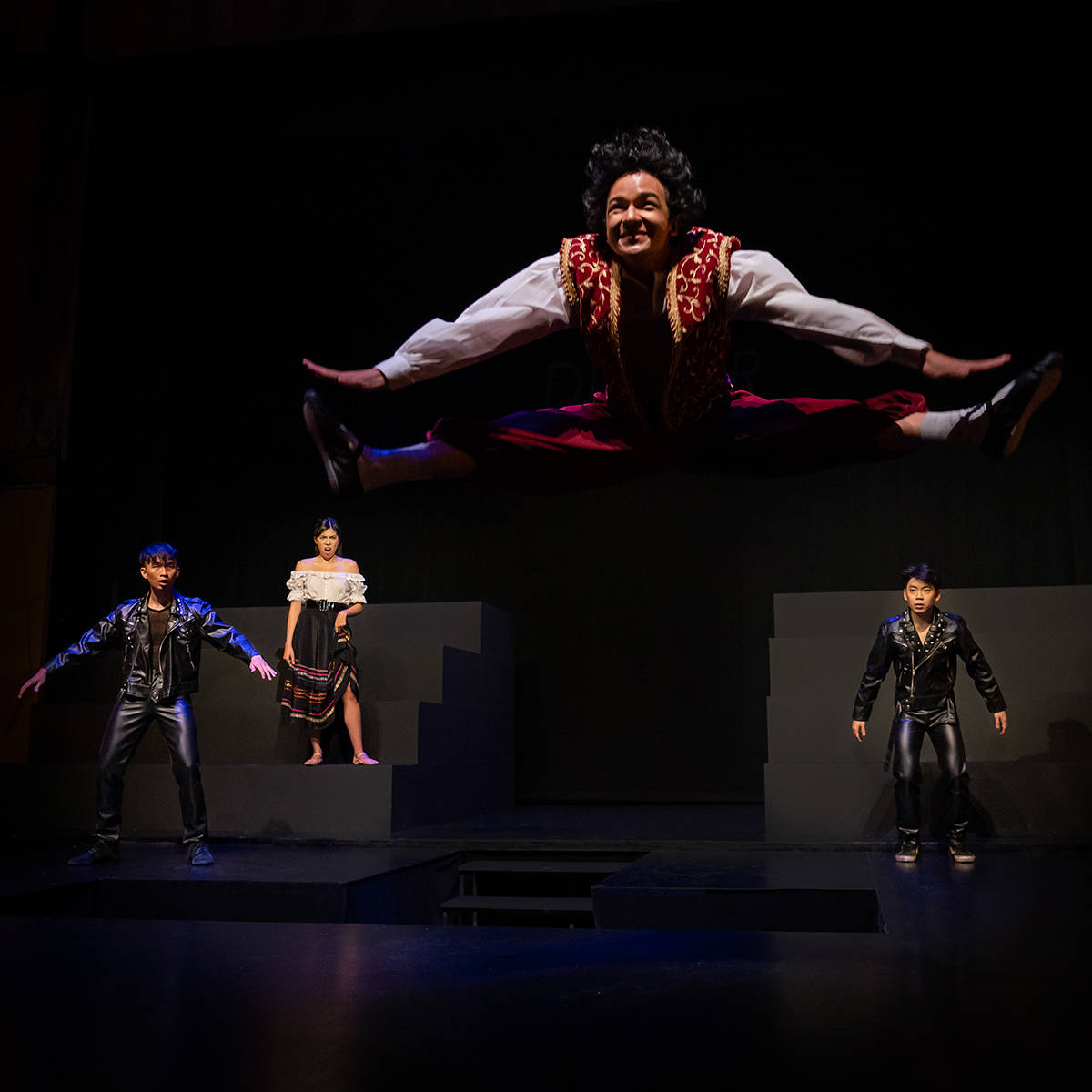


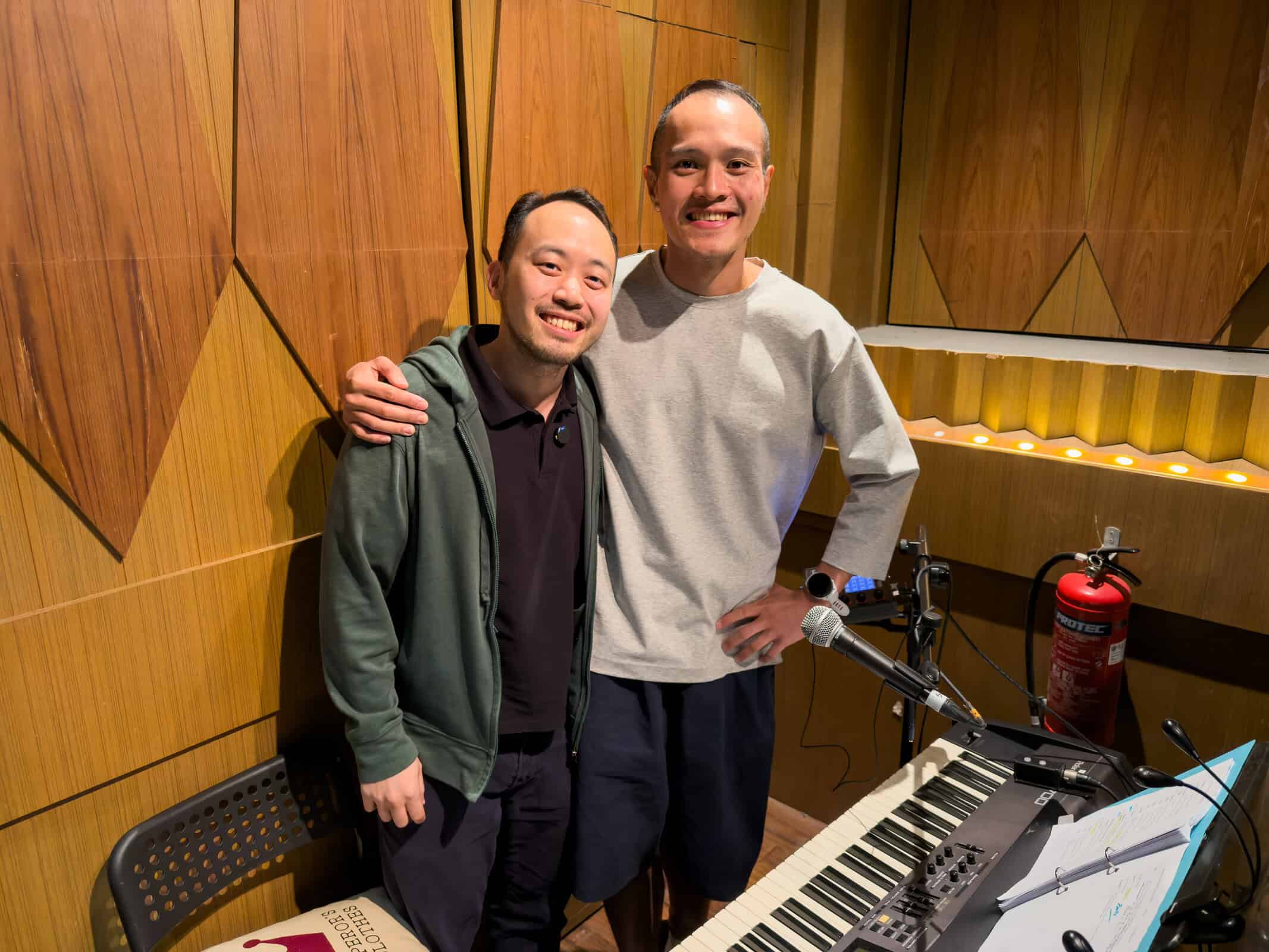
We’re almost done with the 2025 run of The Emperor’s New Clothes! How do you feel?
Julian: I’m exhausted, but very heartened by the audience’s response. What I love most about coming to work every day is seeing how the company works together. My favourite thing is seeing how our technicians and operators and crew treat our children so lovingly behind the scenes. Before every show, they take the children through safety checks. They mic them up. And they just treat them with such kindness and respect.
Joel: I haven’t dipped into the show for a while. But I’ve been following all the Instagram stories, and it’s actually very sweet to see how many children are being so thoroughly entertained by this show. I feel like, at the grand old age of 38, it’s quite a privilege to make children laugh, and to also entertain whole families. I feel very positive about that. I feel like I’m performing a public service. [laughs]
Joel: I also feel really happy that this show is 10 years old. Can you believe it?!
Julian: No!
Joel: We were in our 20s when we first started writing it!
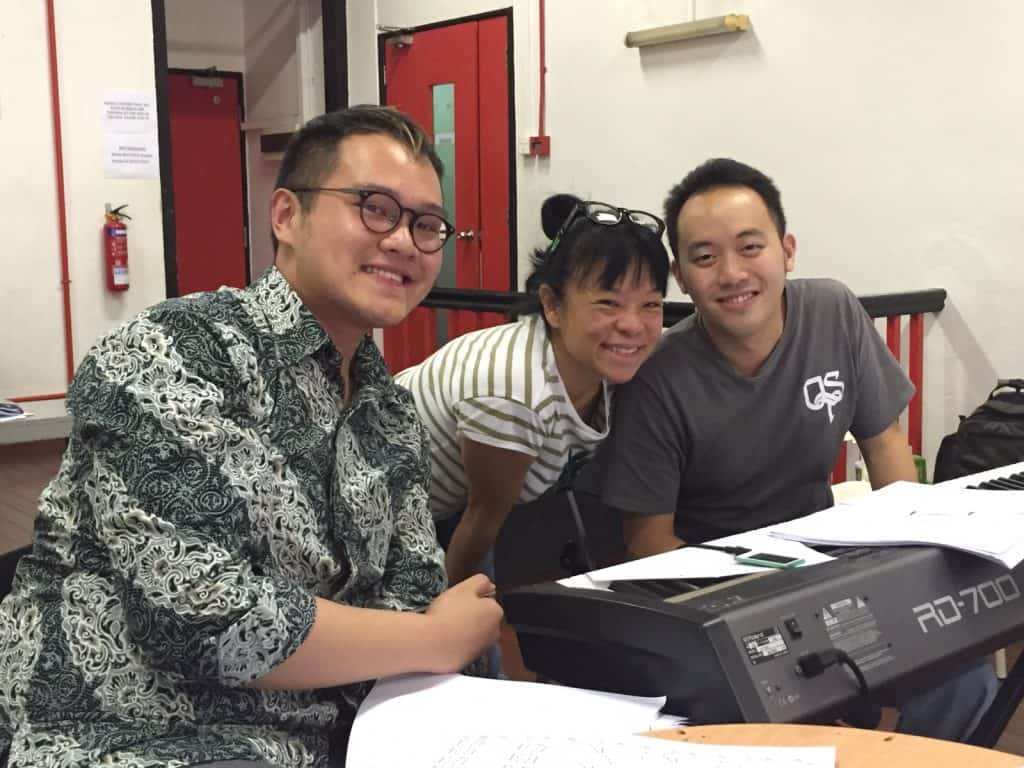
The Emperor’s New Clothes was first staged in 2015. What do you remember about writing it for the first time?
Julian: It was my first panto(mime)! I remember I resisted [doing one] for a while. Ivan Heng [Wild Rice’s Founding Artistic Director] and Pam Oei [director of The Emperor’s New Clothes] had to convince me and say, “Just give it a try”. So I finally gave it a go.
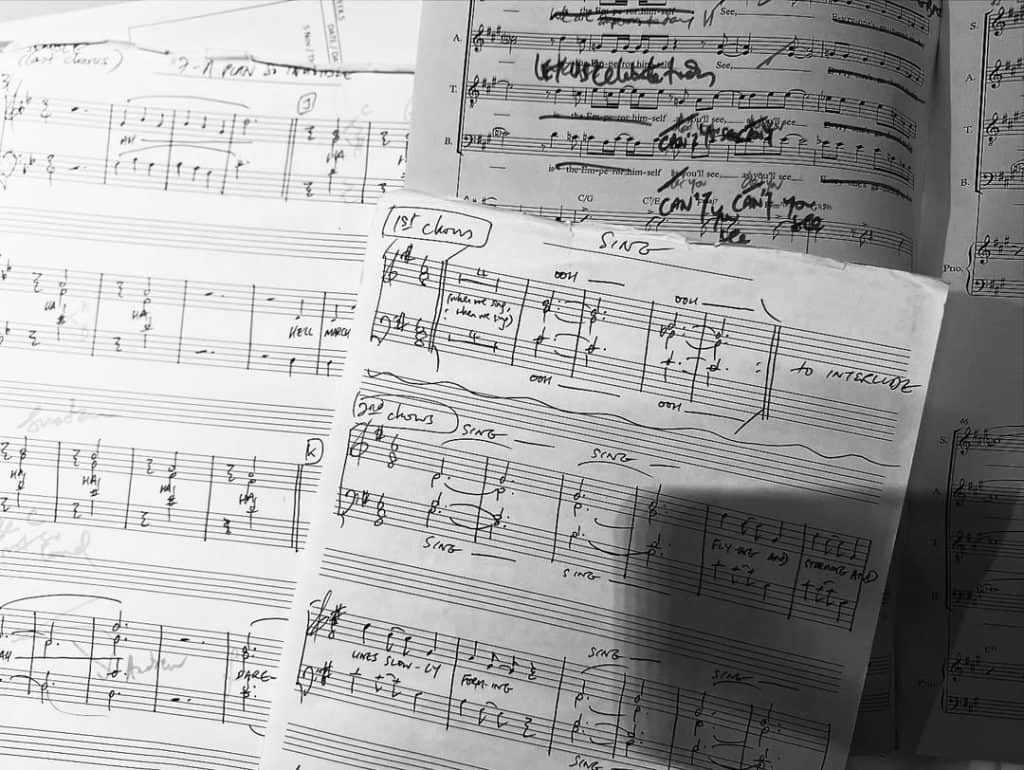
I must say, it was really fortuitous that I was paired with Joel as a lyricist for my first panto. When I started working with him, his words really thrilled me, really tickled my ear. What I love was we approached it as a piece of musical theatre first, without the conventions of the pantomime. So every song that Joel had put down in the script either advanced the plot, or established relationships, or had a very clear function. And that really excited me as a composer.
Joel: This was the first pantomime I wrote from scratch. Prior to this, I’d done Jack and the Bean-Sprout! (2013), which is a reworking of a previous piece, and I was terrified going into it, because the Wild Rice pantomime has a very rich heritage. I, too, was a bit resistant to it. That’s why when I sat down to write it, I was like: let’s make this a piece of musical theatre, as opposed to a traditional pantomime, and I wanted to make it a really solid piece of storytelling.
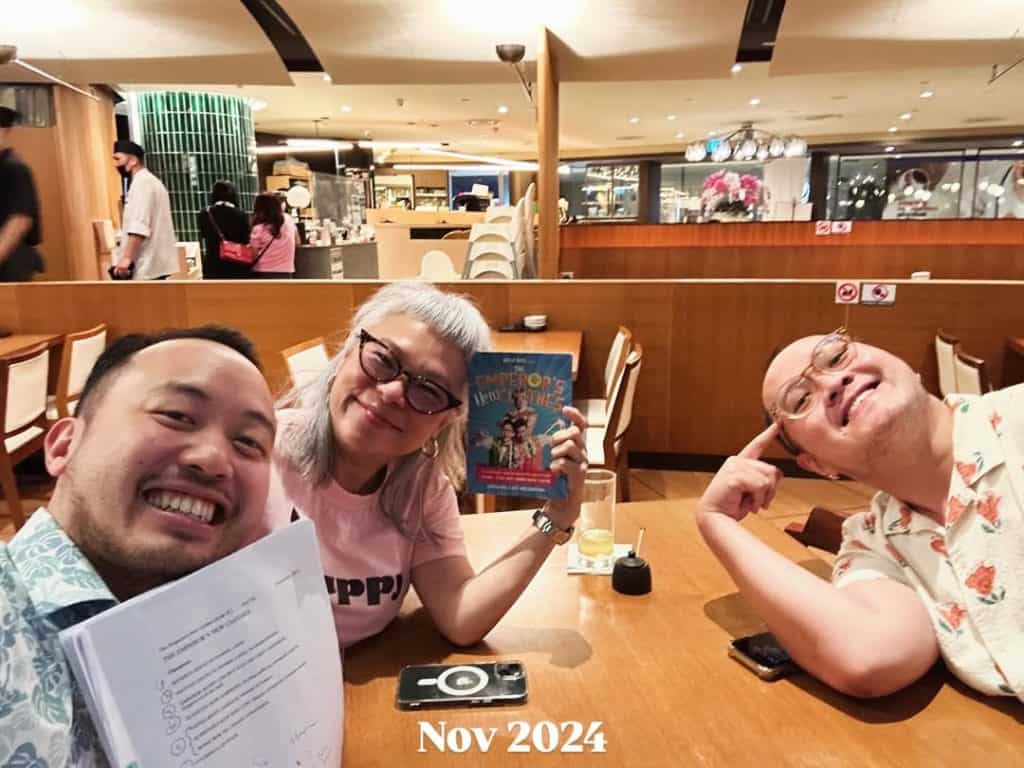
How has the show changed from 2015 to today?
Joel: I really set out to make it a bit lighter on its feet this time. There was just a lot happening in 2015 when we first made it. And I think the show held a lot of things. In hindsight, I kind of had some questions about all of that.
When revisiting the piece, I thought about two things: what would it look like if we made it really light and really joyful and really silly and kind of take out all the darkness and the anger that went into the previous version; and what if we make it 90 minutes long? Making a show tighter is a constant ambition of mine. We worked a lot of very recent current affairs and stuff into it as well. So it actually feels like a fresh, brand-new show in a way.
Julian: I think it makes sense that we looked at it as a different show, because so much time has passed. So we are really responding to society today.
At the same time, what hasn’t changed?
Julian: While Joel has tightened the script and made it very contemporary, the heart of the story still lands.
Joel: I think at the heart of it, it’s a wish for a city built on love and care. Fundamentally, that doesn’t change. Even in this very simple story, we express a hope that those in power may one day see the scope of the things they’ve done to hurt other people and express a wish for them to change, or give way to [others and] newer ways of doing things. I feel like that idea is very alive in the story. That’s my Christmas wish.
You first collaborated on The Emperor’s New Clothes, then several times after. What do you like about working with each other?
Julian: Over the years, we’ve developed a very nice chemistry. There are times when his lyrics come out first, and there are times when I have an idea for a melodic motif or just a tune, and I send it to him. Along the way, we really shape each other’s work.
With Joel, I learned a lot about scansion. He’s very strict with how you set the words to music. So, sometimes, he would say, “Hey, can you set it in a way that the verb lands on the first beat?” Then he’ll sing it to me and contribute a little bit of a melodic idea.
Joel: Yeah, it’s a very back-and-forth process. Actually, I think that’s the best way to work. The back-and-forth [between us] is always so rich and efficient. Julian writes the most beautiful music, so it’s just really nice to have your words set to that kind of soundscape.
What are your favourite songs in this show?
Julian: A Plan So Invisible and Perhaps.
Joel: Yeah, those are my favourites too. I think they’re the most finely constructed ones in the show. But now I think I have to add I Look Left Look Right!
Julian: The thing about Perhaps is we tend to be very scared to write these more adult moments into a pantomime because those are the moments where, usually, children will fidget. But I think Perhaps really establishes the relationship that the Emperor and Empress have and the adults are really listening very closely. The other day, I took a look at the album on Spotify, and it is the top song by a mile.
Joel: To whoever is playing it on loop, I hope your marriage is okay.
There is a lot of waltz music in The Emperor’s New Clothes. Was that intentional?
Joel: I find waltzes very funny! There’s something very pretentious about them, and quite artificial too. Like, triple time is not a natural way that the body wants to move! And that works perfectly with the narrative of The Emperor’s New Clothes, which is about pretense, affect, putting on a show, and not being true to yourself.
Julian: The first waltz we hear is A Plan So Invisible, at the end of Act One, sung by the tailors as they come up with their scheme. When they actually try to dupe the Emperor later on, they sing a very light and more pretentious version of it. So it makes sense to me that both are waltzes! Meanwhile, Perhaps is a ballad of cross-purposes, which goes between triple time and common time. In this instance, the waltz is very wistful and harks back to a happier time, which fits the moment and characters perfectly.
What does The Emperor’s New Clothes mean to you?
Joel: This production actually is quite special because I feel like it solidifies a relationship that I’ve had with Wild Rice for a very long time. It also marks the first time I got to work with my now-frequent collaborators, Julian and Pam. So I feel like it’s a full-circle experience for me beyond just the story. What I also love about The Emperor’s New Clothes is that I think it’s one of the most fully formed and perfect allegories ever written.
Julian: The Emperor’s New Clothes is actually my favourite story of all time. Who knew that an old folk tale from the 19th century would turn out to be the most relevant and contemporary story that plays out every day?
Every night when I do the show, I go home thinking about how, as we get older, it becomes more difficult to call out the truth sometimes. As Ivan always quotes, “theatre holds a mirror to society”, and I think The Emperor’s New Clothes really exemplifies that. I’m so honoured that Wild Rice has chosen it as the grand finale of its 25th-anniversary season!
The Emperor’s New Clothes runs until 21 December 2025. Click here to get your tickets! Our cast recording can be found on Spotify.
Interview by: Rachel Ng, Cass Zheng